
Affidavits
Affidavit of Documents, Individual (Form 30A) — Ontario Civil Procedure
Free template from Minute Notary, an Ontario notary office. The sworn list an individual party to an Ontario Superior Court action serves to disclose every relevant document they have or once had. Prepare the paragraphs and schedules here; the court's own Form 30A is what you serve.
No charge until a notary signs it
Word files are editable. Review any changes carefully before signing or uploading.
Also known as
- Form 30A
- Affidavit of documents Ontario
- Affidavit of documents (individual)
+1 more names
- Rule 30.03 affidavit of documents
The blanks fill themselves in as you type.
- Scope
- General template, not legal advice
- Formats
- PDF + editable Word downloads
- Builder
- Live preview as you type
Affidavit of Documents, Individual (Form 30A) — Ontario Civil Procedure
A compact preview of this template
01The Action
Court file number
Your full name
Do you have documents to list in Schedule A?
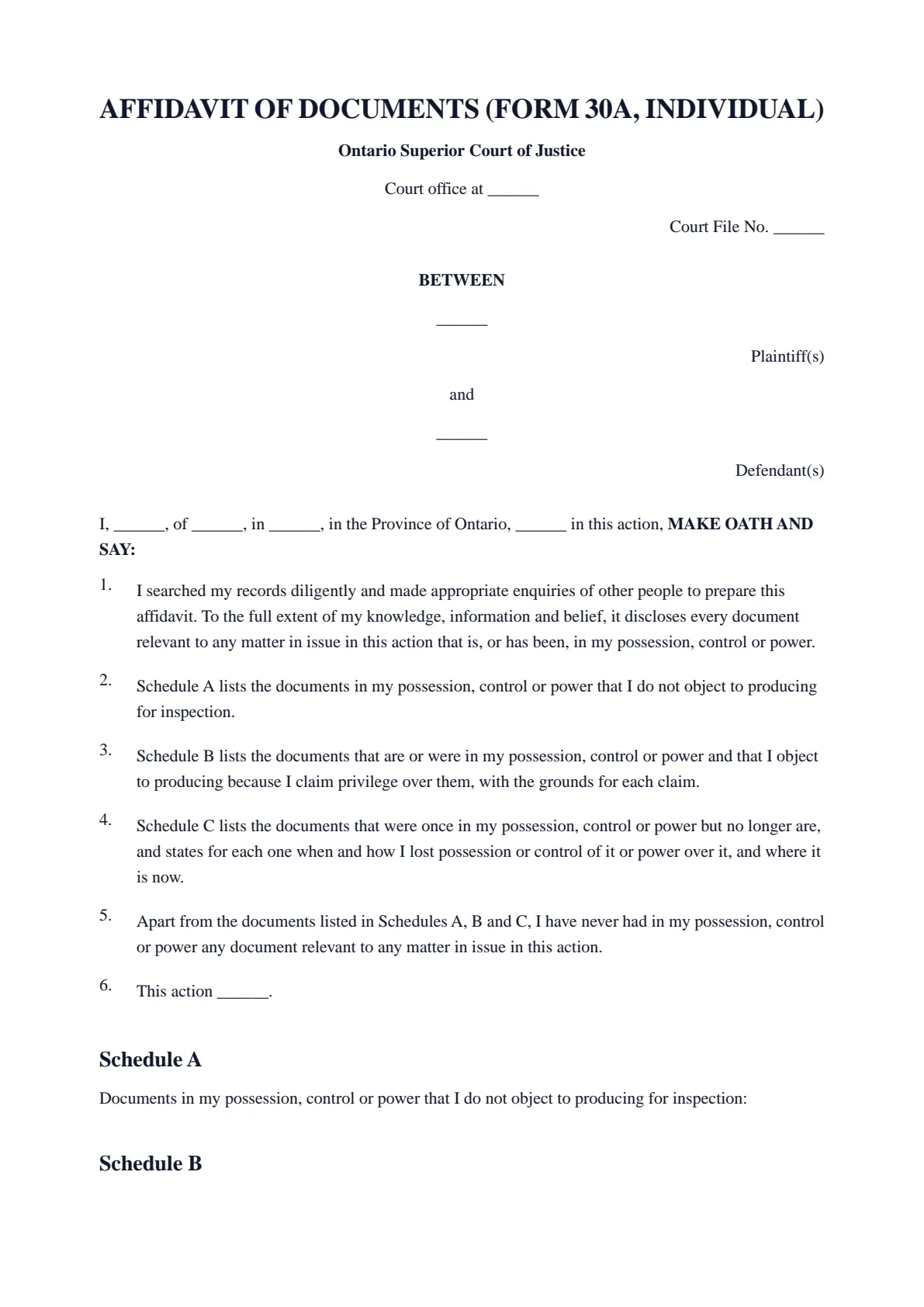
AFFIDAVIT OF DOCUMENTS (FORM 30A, INDIVIDUAL)
Ontario Superior Court of Justice
Court office at ______
Court File No. ______
BETWEEN
______
Plaintiff(s)
and
______
Defendant(s)
I, ______, of ______, in ______, in the Province of Ontario, ______ in this action, MAKE OATH AND SAY:
I searched my records diligently and made appropriate enquiries of other people to prepare this affidavit. To the full extent of my knowledge, information and belief, it discloses every document relevant to any matter in issue in this action that is, or has been, in my possession, control or power.
Schedule A lists the documents in my possession, control or power that I do not object to producing for inspection.
Schedule B lists the documents that are or were in my possession, control or power and that I object to producing because I claim privilege over them, with the grounds for each claim.
Schedule C lists the documents that were once in my possession, control or power but no longer are, and states for each one when and how I lost possession or control of it or power over it, and where it is now.
Apart from the documents listed in Schedules A, B and C, I have never had in my possession, control or power any document relevant to any matter in issue in this action.
This action ______.
Schedule A
Documents in my possession, control or power that I do not object to producing for inspection:
Schedule B
Documents that are or were in my possession, control or power that I object to producing on the grounds of privilege:
Schedule C
Documents that were once in my possession, control or power but no longer are:
Schedule D
Only for an action under the simplified procedure: people who might reasonably be expected to know about the transactions or occurrences in issue.
Signed and sworn (or affirmed/declared) before me by videoconference in Ottawa, Ontario, while the Affiant(s)/Declarant(s) were located in ______________________, on ______________________, pursuant to O. Reg. 431/20, and Electronic Commerce Act, 2000.
______________________________ | ______________________________ |
- 01Work your wayGuided or All fieldsFinish one section at a time, or see every question in one form.
- 02See the resultLive document previewWatch this document update as you add each answer.
- 03Keep your placeSave and restore a draftSave progress in this browser, then restore it later on this device.
How it works
Prepare your document, one step at a time.
Answer the questions, choose the download you need, then continue with signing or booking.
Overview
About this document
- 01
What is an affidavit of documents?
It is your sworn list of the relevant documents, sorted into schedules. 'Document' is wide: the rules include sound recordings, photographs, plans, account books, and data and information in electronic form, such as emails and texts.
Possession, control or power reaches beyond what is in your hands. Under rule 30.01, a document is in your power if you are entitled to get the original or a copy and the party asking for it is not.
- Schedule A: relevant documents you have now and do not object to producing.
- Schedule B: documents you have or had and will not produce because you claim privilege, with the grounds for each claim.
- Schedule C: documents you once had but no longer have, with when and how you lost them and where they are now.
- Schedule D: under the simplified procedure only, the people who might reasonably know about the matters in issue.
- 02
When you need one
Every party to a Superior Court action serves one on every other party, on the dates the parties set in their discovery plan (rule 29.1.03).
In an action under the simplified procedure in Rule 76, it is due within 10 days after the close of pleadings, with copies of the Schedule A documents, and it must list the people who might know about the matters in issue. A person you do not list cannot be called as a witness at trial unless the court orders otherwise (rule 76.03).
If you later obtain another relevant document, or find the affidavit inaccurate or incomplete, you must serve a supplementary affidavit right away (rule 30.07).
- 03
What to include
Work through your records before you start:
- The court file number, the court office, and the parties as they appear on the statement of claim.
- Your city or town, your county or region, and your role in the action.
- Each document numbered, with its nature, its date and enough detail to identify it.
- The grounds of privilege for each Schedule B document.
- For each Schedule C document, when and how you lost it and where it is now.
- Under the simplified procedure, the names, addresses and email addresses (if known) for Schedule D.
- 04
Official source and who accepts it
Ontario Court Services publishes Form 30A as a PDF and a Word file. Copy your prepared paragraphs and schedules onto it, and swear it before a commissioner or notary; its jurat has versions for swearing in person or by video under O. Reg. 431/20.
If you have a lawyer, the lawyer completes the lawyer's certificate on the official form, confirming they explained the duty of full disclosure and the kinds of documents likely to be relevant (and, under the simplified procedure, what rule 76.03 requires). This page leaves the certificate off.
You serve the sworn affidavit on the other parties. It is not filed with the court unless it is relevant to an issue on a pending motion or at trial (rule 30.03 (5)).
- 05
Common mistakes
A favourable document you fail to disclose cannot be used at trial without the judge's leave (rule 30.08). Watch for these:
- Listing only the documents that help you: the duty covers every relevant document.
- Leaving out emails, texts, photos and other electronic records.
- Claiming privilege without stating the grounds for each document.
- Forgetting documents you are entitled to get from someone else, which count as in your power.
- Leaving paragraph 6 in place on the official form when the action is not under the simplified procedure.
- 06
How to get it notarized in Ontario
Fill in the form on this page to prepare your wording, then copy it onto the official form. Do not sign it yet: an affidavit or statutory declaration is signed in front of a notary public or commissioner for taking affidavits, after the oath or affirmation.
When you are ready, book an appointment with Minute Notary and have the official form filled in but unsigned. You can swear or affirm it before a notary by video from anywhere in Ontario, or in person on a mobile visit.
Good to know
Before you fill it in.
Short notes on this template. Worth a minute before you start.
- 01
Prepared for use in Ontario. A general template, not legal advice.
- 02
Notarize online by video across Ontario, or in person anywhere in Ontario.
- 03
Sign in front of the notary, who administers your oath or affirmation and applies the seal.
Frequently asked
Questions about the Affidavit of Documents, Individual (Form 30A) — Ontario Civil Procedure
- Is Form 30A filed with the court?
- Usually not. You serve it on every other party. Rule 30.03 (5) says it is filed only when it is relevant to an issue on a pending motion or at trial.
- What if the party is a company?
- A corporation or a partnership uses Form 30B, the affidavit of documents for a corporation or partnership. This page prepares the individual version only.
- What does claiming privilege mean?
- It means you disclose that the document exists but refuse to produce it, for example because it is a confidential communication with your lawyer. Whether a privilege applies is a question for a lawyer, not the notary.
- Can I swear it by video?
- Yes. The form's own jurat has versions for swearing by video under O. Reg. 431/20, and our notaries can commission it that way from anywhere in Ontario.
- What if I find more documents later?
- Serve a supplementary affidavit right away, disclosing the new documents or correcting the original (rule 30.07).
- Does the notary check my list?
- No. The notary confirms who you are, administers the oath or affirmation and commissions your signature. Making the list complete is your responsibility, and your lawyer's if you have one.
Keep exploring
Related templates
Other documents for civil court, small claims & debts.
- 01Affidavit of Service (Form 16B) — Ontario Rules of Civil Procedure
The proof of service used in an ordinary Superior Court of Justice action, as opposed to a Small Claims or family matter. Prepare your wording here, then swear it before a notary and file on the court's Form 16B.
Fill it out - 02Affidavit of Service (General)
A sworn affidavit proving that court or legal documents were served on another party, including how, when, and where. Fill it in online, download a ready-to-sign PDF, and notarize in Ontario.
Fill it out - 03Affidavit of Service (Form 146A) — Federal Courts of Canada
The proof of service for a Federal Court matter — an immigration judicial review, for example — rather than an Ontario court one. Prepare your wording here, then swear it before a notary.
Fill it out - 04Affidavit of Service (Form 8A) — Ontario Small Claims Court
The sworn proof of service the Ontario Small Claims Court asks for after you serve a claim, defence, or notice. Prepare your wording here, then swear it before a notary — the court's own Form 8A is the version you file.
Fill it out
Ready to sign?
Ready to create your Affidavit of Documents, Individual (Form 30A) — Ontario Civil Procedure?
Fill it in online, then download a ready-to-sign PDF or an editable Word copy. Use the generated PDF to continue to booking. Not sure what the appointment involves? Read about the Affidavits service first.