
Affidavits
Statutory Declaration of Ordinary Residence
Free template from Minute Notary, an Ontario notary office. A sworn declaration confirming that you ordinarily reside in Ontario — for an organization or program that asks you for a sworn statement of your residency. Fill it in online, download a ready-to-sign PDF, and notarize in Ontario.
No charge until a notary signs it
Word files are editable. Review any changes carefully before signing or uploading.
Also known as
- Declaration of Ordinary Residence
- Residency Declaration
- Ordinarily Resident Affidavit
+2 more names
- Sworn Statement of Residency
- Proof of Ontario Residency Declaration
The blanks fill themselves in as you type.
- Scope
- General template, not legal advice
- Formats
- PDF + editable Word downloads
- Builder
- Live preview as you type
Document progress
1 of 5 fields complete
Drafts stay in this browser.
Avoid saving personal information on a shared or public device.
Recommended. Work through one section at a time.
Your full legal name*
Your full address*
Download now or complete it to use for booking.
1 of 4 required fields complete for booking.
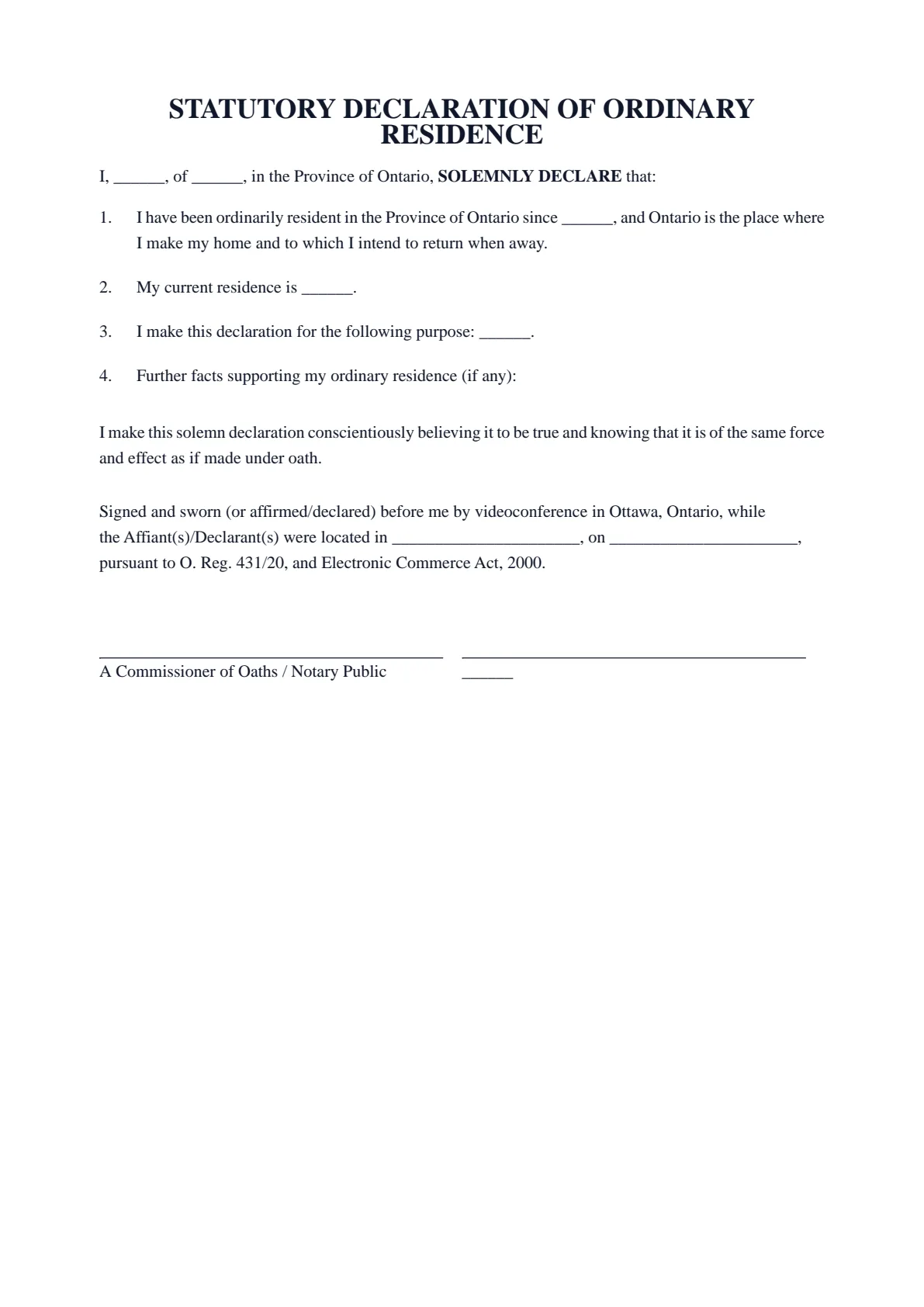
STATUTORY DECLARATION OF ORDINARY RESIDENCE
I, ______, of ______, in the Province of Ontario, SOLEMNLY DECLARE that:
I have been ordinarily resident in the Province of Ontario since ______, and Ontario is the place where I make my home and to which I intend to return when away.
My current residence is ______.
I make this declaration for the following purpose: ______.
Further facts supporting my ordinary residence (if any):
I make this solemn declaration conscientiously believing it to be true and knowing that it is of the same force and effect as if made under oath.
Signed and sworn (or affirmed/declared) before me by videoconference in Ottawa, Ontario, while the Affiant(s)/Declarant(s) were located in ______________________, on ______________________, pursuant to O. Reg. 431/20, and Electronic Commerce Act, 2000.
A Commissioner of Oaths / Notary Public | ______ |
- 01Work your wayGuided or All fieldsFinish one section at a time, or see every question in one form.
- 02See the resultLive document previewWatch this document update as you add each answer.
- 03Keep your placeSave and restore a draftSave progress in this browser, then restore it later on this device.
How it works
Prepare your document, one step at a time.
Answer the questions, choose the download you need, then continue with signing or booking.
Overview
About this document
- 01
What is an ordinary residence declaration?
It is a sworn statement — also called a declaration of ordinary residence or residency declaration — confirming that Ontario is where you ordinarily make your home.
It is used where eligibility for a benefit, rate, or program depends on residing in the province, and differs from a simple proof of address.
- 02
When you might need one
It supports residency-based eligibility.
- A program asks you to confirm under oath that Ontario is your home.
- An organization asks for sworn confirmation of how long you have lived in Ontario.
- Supporting eligibility that depends on ordinarily residing in Ontario.
- 03
What to include
Confirm that you ordinarily reside in Ontario, your address, and since when, and explain your connection to the province. Each program sets its own residency rules; keep supporting documents available if requested.
- 04
How to notarize a statutory declaration of ordinary residence in Ontario
After you fill in your statutory declaration of ordinary residence and download the PDF, do not sign it in advance. A sworn document must be signed in front of a notary public or commissioner for taking affidavits, who administers your oath or solemn affirmation first.
Minute Notary commissions your statutory declaration of ordinary residence online by secure video, under Ontario's remote commissioning rules (O. Reg. 431/20), or in person anywhere in Ontario. Bring valid government-issued photo identification so we can verify your identity before applying the notary seal.
Field guide
Every box, explained.
What each box in the Statutory Declaration of Ordinary Residence asks for, in the same order as the form. Tap or click any box below to see what it means, when it applies and how to fill it in.
- Boxes
- 5
- Required
- 4
- Sections
- 2
Before you start
Have at hand the photo ID you will show at the signing, and the date you began living in Ontario with a paper that shows it, such as a lease. Ask the program that wants this declaration how it decides who is a resident. The page says each program sets its own residency rules and may ask for supporting documents.
1.1Your full legal nameRequiredYour own full legal name: you are the person whose home in Ontario this declaration describes.See how to fill it inHide the details
- What it means
- It opens the document ('I, …, of …, SOLEMNLY DECLARE that') and prints under your signature line. To solemnly declare is to state formally that something is true, before a commissioner (an official allowed to take oaths and declarations). The closing line gives it the same force as an oath.
- When it applies
- The document speaks of 'I' and 'my home': one person makes each declaration, about where they live. If the program needs proof of residence for someone else, such as a child, ask it who should make the declaration.
- How to fill it in
- Write your first, middle and last names in full, as on the government-issued photo ID you bring to the signing. Avoid nicknames and initials unless your ID uses them. If the program has you under another version of your name, keep the name on your ID here and speak to the notary before you sign.
Example Your full legal name
Maria Lopez
1.2Your full addressRequiredYour full home address in Ontario: where you live now.See how to fill it inHide the details
- What it means
- It prints twice: in the opening line ('I, [name], of [address], in the Province of Ontario') and as paragraph 2, 'My current residence is [address].' So you declare it as your present home.
- When it applies
- Use where you live today; if you live with family and have no lease, use that address. If you are living outside Ontario for now (studies, work), or have homes in two places, the fixed lines may not fit: speak to the notary before you sign.
- How to fill it in
- Type it on one line with commas: unit, street number and name, city, province and postal code. Write it as it appears on papers sent to you there, such as a lease or a bill. Write your home address even if you will be elsewhere during a video appointment: the closing line records that place separately.
Example Your full address
Unit 4, 123 Example Street, Ottawa, ON K1A 0B1
Good to know
Before you fill it in.
Short notes on this template. Worth a minute before you start.
- 01
Prepared for use in Ontario. A general template, not legal advice.
- 02
Fill it in online for free and download a ready-to-sign PDF — no account required.
- 03
Sign in front of the notary, who administers your oath or affirmation and applies the seal.
- 04
Notarize online by video across Ontario, or in person anywhere in Ontario.
Frequently asked
Questions about the Statutory Declaration of Ordinary Residence
- What is ordinary residence?
- It is the place where you ordinarily make your home and live. An ordinary residence declaration confirms that Ontario is that place, for eligibility purposes.
- How is it different from proof of address?
- Proof of address confirms where you live now; ordinary residence focuses on Ontario being your settled home, for a program whose rules depend on it. OHIP does not take a declaration: it asks for a document from its own list, such as a lease or utility bill.
- Can I notarize it online in Ontario?
- Yes. You can swear it online by video under Ontario’s remote commissioning rules, or in person anywhere in Ontario with Minute Notary.
- Does it decide my eligibility?
- No. It supports your case; each program applies its own residency rules and may ask for supporting documents.
Keep exploring
Related templates
Other documents for general affidavits & sworn statements.
- 01Affidavit of Residency
A sworn affidavit confirming where you live and since when — for an organization that accepts sworn proof of address or residency. Fill it in online, download a ready-to-sign PDF, and notarize in Ontario.
Fill it out - 02Tenant's Declaration of Residence
A sworn statement by a tenant or resident confirming that they live at a given address — useful as proof of residence where a lease or bill is unavailable. Fill it in online, download a ready-to-sign PDF, and notarize in Ontario.
Fill it out - 03Statutory Declaration of Dependency
A sworn declaration confirming that another person depends on you financially — for an insurer, plan or organization that asks for a sworn statement. Fill it in online, download a ready-to-sign PDF, and notarize in Ontario.
Fill it out - 04Statutory Declaration of Revocation of Authorization
A sworn declaration revoking an authorization or consent you previously gave — used to formally end someone’s authority to act for you. Fill it in online, download a ready-to-sign PDF, and notarize in Ontario.
Fill it out
Ready to sign?
Ready to create your Statutory Declaration of Ordinary Residence?
Fill it in online, then download a ready-to-sign PDF or an editable Word copy. Use the generated PDF to continue to booking. Not sure what the appointment involves? Read about the Statutory Declarations service first.